
Why Am I Not Getting Better? The Healing Hierarchy Explained
Why Am I Not Getting Better? The Healing Hierarchy Explained
If you’re not getting better despite doing everything right, you are not alone.
This is one of the most common patterns I see in clinic — informed, motivated people spending real money on their health, but progress has stalled. The frustration doesn’t come from lack of effort. It comes from something almost nobody talks about: healing has an order, and when that order is wrong, even the right things stop working.
Why You’re Not Getting Better — Your Body Is in Protection Mode
Think of your body’s resilience like a glass of water that fills slowly over time.
Each stressor adds a little more. A viral infection. A prolonged period of stress. Years of disrupted sleep. Pushing through exhaustion when the body needed rest. Nutritional gaps that quietly accumulated. Hormonal shifts that nobody addressed properly.
Nothing catastrophic on its own. But eventually the glass overflows.
When that happens, something shifts. The body stops responding the way it used to. It goes into a kind of protection mode — slowing things down, becoming reactive, conserving whatever resources it has left.
This isn’t dysfunction. It’s the body doing exactly what it’s designed to do when it perceives that demands are exceeding capacity.
The signs are unmistakable once you know what to look for:
- Fatigue that doesn’t improve even after a genuinely good night of sleep
- Weight that won’t shift despite real and sustained effort with food
- Gut symptoms that continue even on a strict elimination diet
- Hormones that stay unpredictable despite months of trying to address them
- Good days followed by sudden crashes that seem to come from nowhere
- Blood tests that come back “normal” — but you feel anything but
- Brain fog that makes it difficult to think clearly regardless of how much rest you’ve had
The body hasn’t given up. It’s protecting itself.
And that distinction matters enormously for what you do next.
This is also explored in depth in our article on why treating symptoms isn’t the same as healing — a distinction that sits at the heart of the functional medicine approach.
Why Doing More Keeps You Not Getting Better
The instinct when we feel stuck is to add more. More supplements. More protocols. More interventions. More restrictive diets.
But when the body is in protection mode, adding more inputs often increases the problem rather than solving it.
Here’s why: for a supplement to work, your body needs to be in a position to actually use it — to absorb it, process it, and respond to it. When the body is already overwhelmed, that processing capacity simply isn’t available. So things get added, money gets spent, and very little shifts.
A few examples that often surprise people:
Probiotics with undetected bacterial overgrowth
If there is bacterial overgrowth in the small intestine that hasn’t been identified, adding probiotics can feed the problem rather than fix it. Bloating and discomfort often worsen rather than improve — not because probiotics are harmful, but because the environment they’re being introduced into isn’t ready for them.
Adaptogenic herbs when the body is running on empty
Herbs like ashwagandha and rhodiola are commonly taken to support energy and stress resilience. But when the body’s stress response is already exhausted, these herbs push a system that has nothing left to give. The result is often feeling more wired, more anxious, or even more depleted — the opposite of the intended effect.
Iron supplements when inflammation is elevated
When there is significant underlying inflammation, the body actively restricts iron from being properly used — a well-documented physiological response known as anaemia of chronic disease. Supplementing iron in this state can raise ferritin numbers on paper without improving how you actually feel, because the iron can’t be utilised properly until the inflammation is addressed first. Research published in journals including Blood journal has documented this relationship extensively.
These aren’t bad supplements or bad choices. The problem isn’t what’s being taken — it’s that the body isn’t yet in a position to respond to them.
This is also why comprehensive functional testing is so valuable. Without data, it’s almost impossible to know which systems are stable and which aren’t — meaning even well-intentioned interventions can work against recovery.
The Healing Hierarchy: The Order That Gets You Better
Over many years in clinical practice, a pattern became clear.
The people who recovered most consistently were rarely the ones doing the most. They were the ones doing things in the right order.
When certain foundations were restored first, the body became responsive again. Things that previously seemed to do nothing suddenly started making a real difference. The same person, the same supplements, a different sequence — and a completely different outcome.
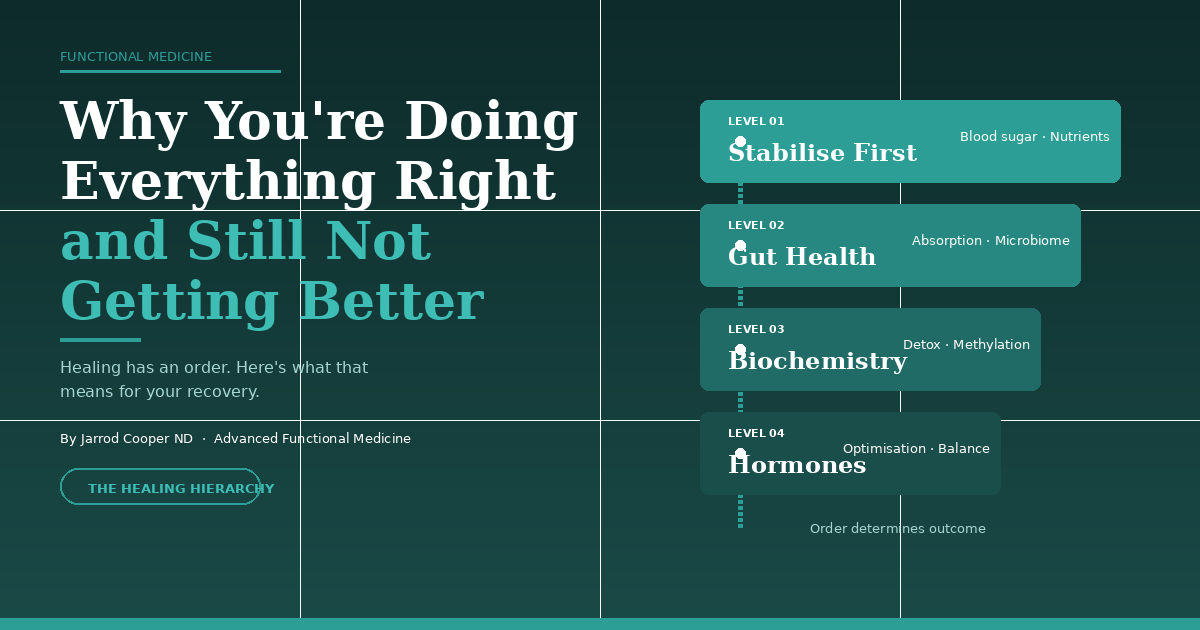
This observation became the framework I now call The Healing Hierarchy.
It’s a way of understanding that the body tends to recover in layers, and that each layer needs to be stable before the next one can properly respond. The functional medicine approach is built on exactly this kind of systems thinking — treating the body as an interconnected whole rather than a collection of isolated symptoms.
Level 1 — Stabilise First
Before anything else, the body needs to be stable enough to actually heal. This means addressing the non-negotiables that everything else depends on: blood sugar stability, critical deficiencies like iron, B12 and vitamin D, calming acute inflammation, and supporting nervous system regulation.
Without this foundation, nothing downstream works reliably. The body is still in survival mode — and survival mode is incompatible with repair.
Level 2 — Gut Health
Once stability is restored, gut health takes priority — even when digestive symptoms aren’t the main complaint.
The gut is far more than a digestive organ. It governs how well nutrients are absorbed, houses a significant portion of immune activity, produces neurotransmitters, and communicates directly with the brain through the vagus nerve. If the gut lining is compromised — which in a body under chronic stress it very often is — even the best supplements aren’t reliably reaching the cells that need them.
This is why the gut-thyroid connection is so often overlooked. People spend years on thyroid medication with partial results, not realising that gut dysfunction is silently undermining every other layer. You can read more about leaky gut syndrome and its broader impact on systemic health in our health library.
The gut microbiome’s role in immune regulation is also increasingly well-documented in the research literature — with studies showing that gut dysbiosis contributes to systemic inflammation across a wide range of chronic conditions.
Level 3 — Biochemistry and Detoxification
Once the gut is functioning properly, the focus shifts to how the body processes and clears things internally — detoxification pathways, methylation, and cellular energy production.
When these pathways are impaired, even a clean diet and good supplementation can’t fully restore function. This is why aggressive detox protocols attempted too early often backfire — they move material through a system that isn’t yet ready to handle it, creating more symptoms rather than fewer.
When this layer is addressed in the right sequence, cognitive clarity tends to improve, energy stabilises, and hormonal signalling becomes more predictable.
Level 4 — Hormones and Optimisation
Hormones are often the most visible problem and the first place people focus their attention. But hormonal balance is downstream of everything above it.
Hormonal signalling depends on stable blood sugar, functional gut absorption, and intact detox pathways. When those foundations are compromised, hormonal interventions tend to deliver inconsistent and short-lived results — sometimes for years.
When the foundations are restored first, hormonal function often improves significantly on its own — sometimes without aggressive intervention at all. This is one of the most consistent observations in clinical functional medicine practice.
The Question Worth Asking
If you’ve been doing many things right but not seeing the progress you expected, the most useful question to ask yourself isn’t:
“What else should I be adding?”
It’s:
“Am I doing the right things in the right order?”
Healing is not random. It has a sequence. And once you understand that sequence, things that previously seemed to do nothing can start making a real difference.
This is the foundation of how we approach recovery at Advanced Functional Medicine — whether through our online program, which walks through this sequence step by step, or through a personalised consultation for those who want direct clinical support.
Where to Start
If you recognise yourself in this article, a good first step is getting clear on which layer needs attention. That usually requires data — which is why structured functional testing is so often the starting point for genuine recovery.
You can explore our approach to essential functional testing, browse over 200 articles in our health library, or watch our free webinar on the foundational steps to reversing chronic disease.
The body is not broken. In most cases, it is simply waiting for the right conditions — in the right order.
Written by Jarrod Cooper ND — Naturopathic Doctor and Functional Medicine Practitioner. Jarrod works with patients in Australia and worldwide through Advanced Functional Medicine and the Functional Medicine Solution online program.
The above information is intended to be general, educational advice only, on topics which are of interest to us. It is not intended to represent specific or individual health or medical advice and is not specific to your situation. The below information is educative and is not intended to advertise any service.
Before making any decisions in relation to your health, you should always discuss your individual situation with your own health practitioners to ensure that any advice you have read is right for you.

Jarrod Cooper
Jarrod Cooper – ND is the founder of Advanced Functional Medicine Australia. He is a Naturopathic Doctor with extensive functional medicine training from leading practitioners in the USA and worldwide.
He is leading the way with advancements of functional medicine, clinically implementing worldwide best practices in Functional Medicine throughout Australia.
Jarrod consults in person from Perth, Western Australia and also online via Telehealth throughout Australia and worldwide.
If you are looking for personalised treatment, we highly recommend contacting Jarrod Cooper’s Advanced Functional Medicine clinic in Australia.

