
Why Treating Symptoms Isn’t the Same as Healing in Functional Medicine

Why Treating Symptoms Isn’t the Same as Healing in Functional Medicine
Why Treating Symptoms Isn’t the Same as Healing

If you’ve been dealing with ongoing health issues — digestive problems, fatigue, brain fog, hormone symptoms, stubborn weight, or inflammatory conditions — you may recognise this pattern: you treat one symptom, it improves a little, then something else appears, or the original problem slowly returns. This is the core problem of treating symptoms vs healing — and it’s one of the biggest reasons chronic illness becomes chronic.
This cycle is extremely common. Not because your body is broken. Not because you’ve failed at health. But because symptoms are not the same thing as causes.
Most healthcare systems are built around identifying a diagnosis and managing the symptoms associated with it. That approach has its place, especially in acute care situations. But for chronic, complex conditions, symptom management alone rarely produces true recovery.
Functional medicine starts from a different place: why is this happening in the first place?
Treating Symptoms vs Healing: Symptoms Are Messages
Symptoms are not the enemy. They are signals the body uses to communicate stress or imbalance.
For example:
-
Fatigue may reflect mitochondrial dysfunction, inflammation, nutrient depletion, blood sugar instability, or gut-driven immune activation
-
Bloating or reflux may point toward microbial imbalance, low stomach acid, motility issues, or food sensitivities
-
Anxiety may involve neurotransmitter imbalance, inflammation, blood sugar swings, or gut–brain axis disruption
These are not random malfunctions. They are adaptive responses.
Many chronic diseases share common upstream drivers such as inflammation, oxidative stress, insulin resistance, gut barrier dysfunction, and mitochondrial impairment 1. If those drivers remain unaddressed, suppressing symptoms simply diverts the problem elsewhere. This is why people often collect diagnoses over time. This is the fundamental difference between treating symptoms vs healing — one suppresses signals, the other resolves what is driving them.
The Body Works as a Network
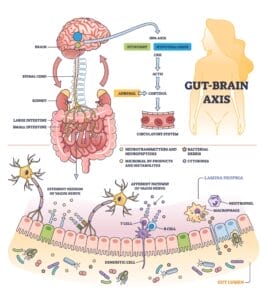
The body does not operate in isolated compartments. Your gut influences your immune system. Your immune system influences your brain. Your brain influences hormones. Hormones shape metabolism. Metabolism affects mitochondrial energy production.
The gut health microbiome plays a central role in immune regulation, neurotransmitter production, and metabolic signalling 2. Mitochondrial dysfunction contributes to fatigue, cognitive decline, ageing, and many chronic diseases 3. Insulin resistance promotes inflammation, cardiovascular disease, hormone disruption, and neurodegeneration 4.
When one system becomes strained, others rarely escape unscathed. This interconnectedness explains why chasing isolated symptoms rarely creates lasting change.
When “Normal” Isn’t Optimal
Standard reference ranges are designed to detect disease, not early dysfunction. You can be told everything is “normal” and still feel far from well.
Common examples:
- Fasting glucose looks normal, but insulin is already elevated
- TSH sits in range, while tissue-level thyroid activity is impaired
- Ferritin appears adequate, but iron utilisation is poor
- CRP is normal, despite ongoing inflammatory signalling
Early metabolic and inflammatory changes often exist years before diagnosable disease develops 5. Functional medicine looks beyond cut-offs. We look for patterns.
Root Causes Are Usually Layered
Chronic illness rarely comes from one single factor. More often, it develops from multiple layers interacting over time, including:
- Gut dysbiosis
- Nutrient insufficiencies
- Environmental toxin exposure
- Chronic stress
- Poor sleep
- Blood sugar instability
- Hormonal shifts
- Genetic vulnerabilities
For example, gut dysbiosis can increase intestinal permeability, allowing bacterial endotoxins into circulation and driving systemic inflammation and insulin resistance 6. Inflammation impairs mitochondrial energy production 7. Low cellular energy reduces detoxification capacity and hormone clearance. Over time, resilience drops. Symptoms appear. Many people experience stubborn weight despite eating less but not losing weight.
What Healing Looks Like in Practice
Rather than asking, “What treats this symptom?”, functional medicine asks: what is driving this pattern? This shift is the heart of treating symptoms vs root cause healing.
Identify Core Imbalances (Root Cause Healing)
Assessment commonly includes:
- Gut function and microbiome
- Inflammatory markers
- Metabolic health and insulin signalling
- Hormones
- Nutrient status
- Detoxification capacity
- Mitochondrial function
- Sometimes genetics
Reduce Key Stressors
This may involve:
- Addressing pathogenic microbes
- Removing food triggers
- Reducing toxic exposures
- Stabilising blood sugar
- Lowering inflammatory inputs
- Reducing pathogenic gut organisms has been shown to lower inflammatory burden and improve metabolic outcomes 8.
Restore Foundations
Healing often requires rebuilding:
- Gut lining integrity
- Digestive capacity
- Nutrient sufficiency
- Antioxidant systems
- Mitochondrial cofactors
Nutrients such as magnesium, B vitamins, CoQ10, and carnitine are essential for ATP production 9. Without energy, healing cannot proceed.
Rebalance Regulation Systems
This includes supporting:
- Blood sugar control
- Stress-response physiology
- Thyroid function
- Sex hormone metabolism
- Neurotransmitter balance
Improving insulin sensitivity reduces inflammatory signalling and cardiometabolic risk 10.
Optimise for Long-Term Health
Once stability is restored, focus shifts to:
- Longevity pathways
- Muscle and bone preservation
- Cognitive resilience
- Cardiovascular health
- Cancer-protective physiology
Lifestyle medicine and nutrition quality strongly influence healthspan and lifespan 11.
Why This Approach Works
When upstream drivers are addressed:
- Symptoms fade naturally
- Resilience increases
- Relapses become less frequent
- The body tolerates stress better
You are no longer propping up a struggling system. You are restoring capacity. That is the difference between management and healing. This is why treating symptoms vs healing leads to very different long-term outcomes.
A Better Question
Instead of asking, “What can I take for this?”, try asking: what is this symptom telling me about my physiology?
Where to Start
For many people, high-impact starting points include:
- Comprehensive stool testing
- Metabolic and insulin markers
- Nutrient status
- Thyroid and hormone panels
- Inflammatory markers
From there, a personalised roadmap can be built based on your biology. Not guesswork. Not generic protocols. Not symptom chasing.
Final Thought
Your body is not broken. It is adaptive. It is responding intelligently to unresolved biological stress. When those stresses are identified and corrected, healing becomes not mysterious, but predictable.
The above information is intended to be general, educational advice only, on topics which are of interest to us. It is not intended to represent specific or individual health or medical advice and is not specific to your situation. The below information is educative and is not intended to advertise any service.
Before making any decisions in relation to your health, you should always discuss your individual situation with your own health practitioners to ensure that any advice you have read is right for you.

Jarrod Cooper
Jarrod Cooper – ND is the founder of Advanced Functional Medicine Australia. He is a Naturopathic Doctor with extensive functional medicine training from leading practitioners in the USA and worldwide.
He is leading the way with advancements of functional medicine, clinically implementing worldwide best practices in Functional Medicine throughout Australia.
Jarrod consults in person from Perth, Western Australia and also online via Telehealth throughout Australia and worldwide.
If you are looking for personalised treatment, we highly recommend contacting Jarrod Cooper’s Advanced Functional Medicine clinic in Australia.

